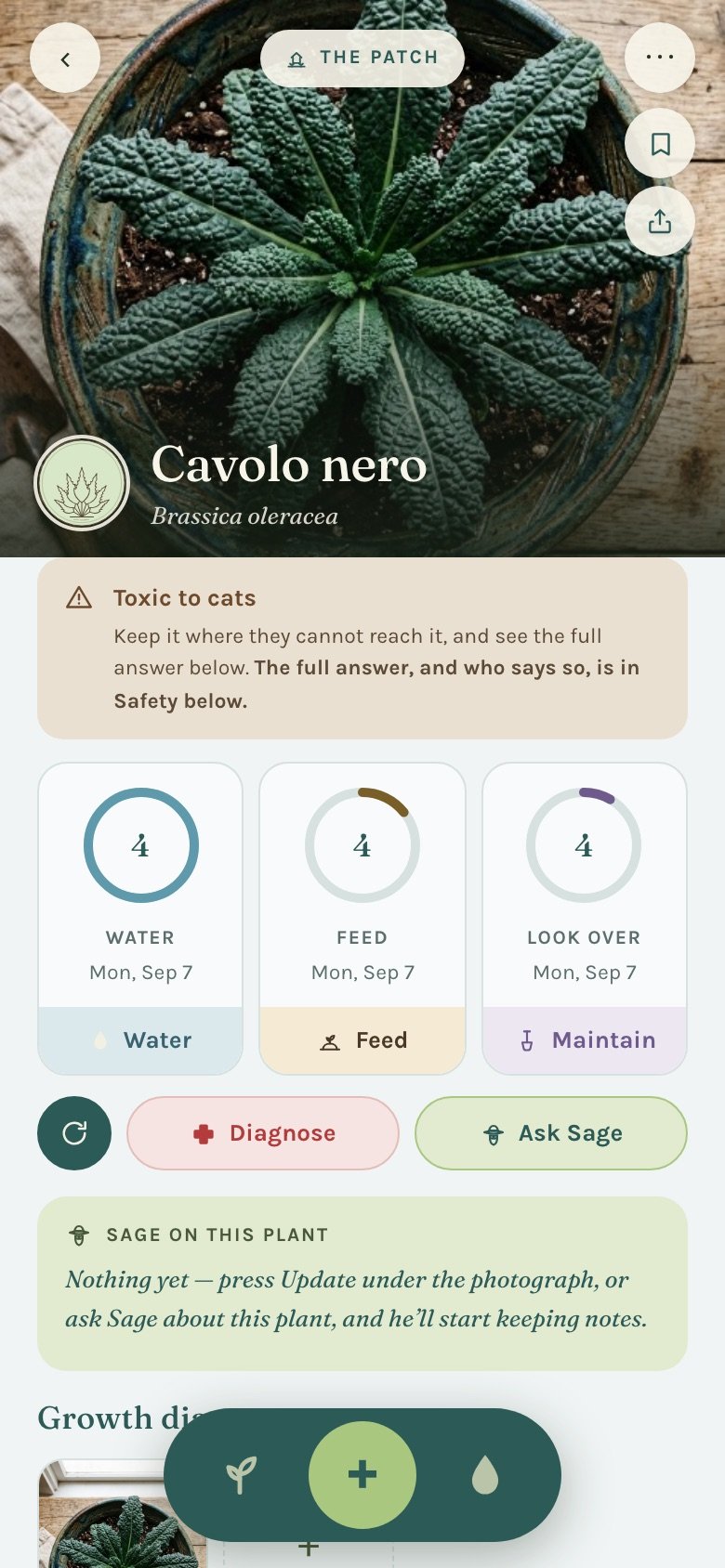
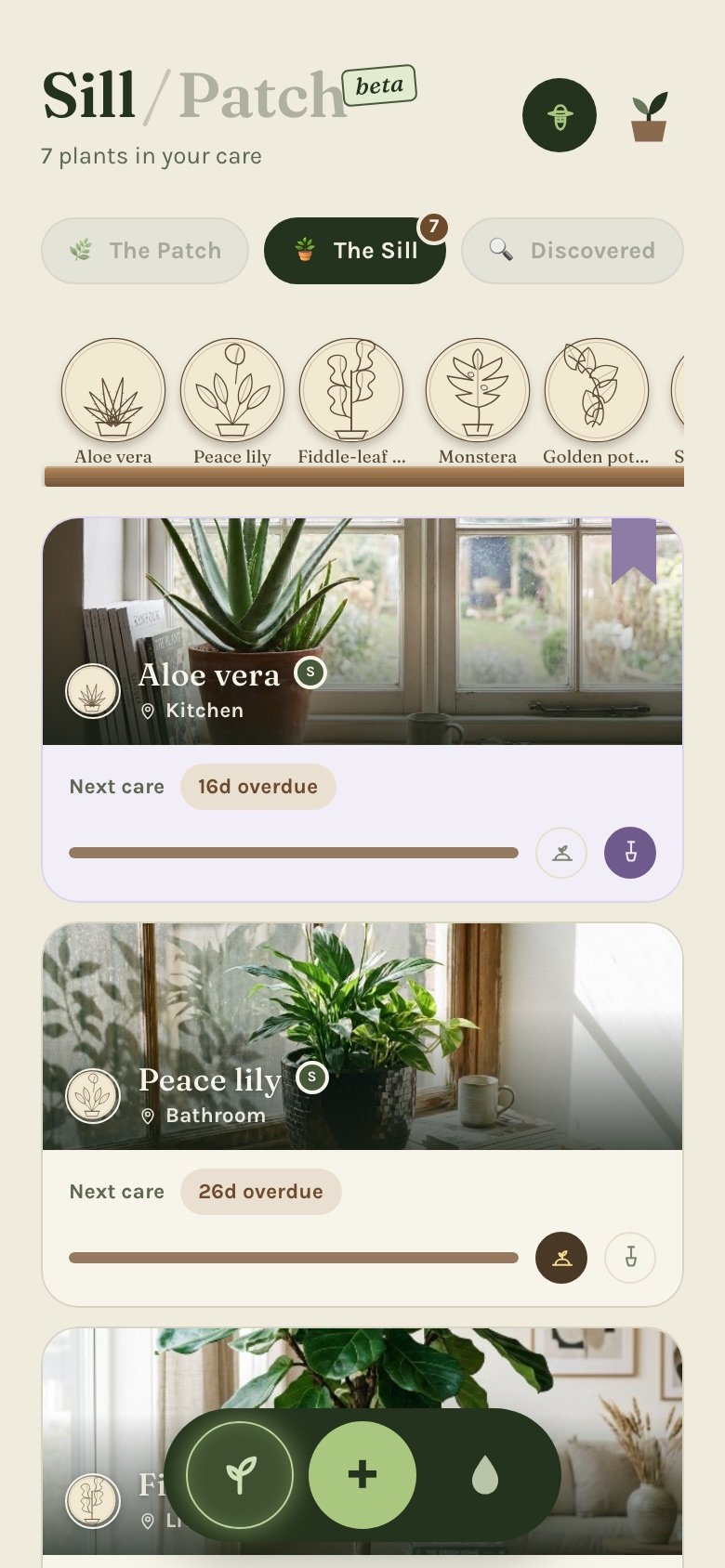
Photograph a plant and it's named, scheduled and looked after — on the windowsill or out in the beds. Sage remembers every one.
A week of Home, then Free for good. No card.
IndoorsOutdoors
Healthy plants, inside and out
A windowsill and a garden need different things. Sage knows which.
Your Sill holds the pots indoors. Your Patch holds what grows outside, under a sky Sage reads for your own address. Switch between them.
The Sill — indoors
Pots indoors, each on its own rhythm: set by the plant, the season and the size of its pot, and explained on every date.
Every date says whyNot a fixed “every 7 days”. Each plant keeps its own interval, is never due before it, and the reason is written under the date: “Its 9-day mark falls on Saturday, and Monday is the next day you’re caring for this room.”
How much to pourMeasure the pot across the top and it tells you how much water it can take, rounded to what a jug can measure. No more “water thoroughly”.
Weather at the glassA frost outside chills anything resting on the pane. Sage warns about cold glass, a hot sill and a short winter day, which is a windowsill’s own weather.
Rain countsWhen more than 10 mm falls, it’s written into each plant’s history as a real watering, and the next date moves for a reason you can read. Rain on the way? Sage says to hold the can.
Frost, soil and your zoneAdvice put together from the forecast for your address: soil too cold to plant, mildew weather, ground still saturated. Your hardiness zone is worked out from ten years of records, and the sheet says so.
Feeding and harvestFeed plans and picking windows for the things you actually grow to eat.
Your first week is Home, which keeps both rooms and reads the weather for them. After it, Free keeps one room, for good.
A look inside
Everything a plant asks of you, quietly handled.
One calm calendar
One day, not every day.
Tell Sage how much time you actually have, and he folds watering, feeding and look-overs — across every space you keep — into the fewest days that still keep the plants well.
Water, feed and look-over days on one grid
Set a weekly care budget — it plans to fit
Print the week, or save it as a PDF
Going away? Every care day inside your dates steps to the first visit after you're back
The week ahead
July · both spaces
Water Feed Look-over
M
T
W
T
F
S
S
14
15
16
17
18
19
20
21
22
23
24
25
26
27
Two watering days · about 15 minutes all week.
Diagnose, then follow it through
From worried to well.
Photograph what’s wrong and Sage asks two or three things first. Is the compost wet? Overwatering and underwatering look the same in a photograph, so he asks. Then he tells you what it most likely is, how serious it is, and what to do. Agree a remedy and it goes on the calendar as dated steps, and the plant sits in Watching until it mends.
He asks before he answers, and the questions cost nothing
Reads this plant’s own watering history, and the problems already known for its species
A treatment course that ends by itself, with a date to look again
Diagnose
the peace lily
Is the compost wet?Still wet
Root stress from overwatering
Medium severity
Why: The lower leaves are yellowing and the soil's stayed wet for weeks — roots can't breathe in soil that never dries.
Do this: Let it dry out fully before the next watering, and check the pot actually drains.
✓ Following this — I'll check back in a few days.
Other people
Share the care. Show off a little.
Put the household’s names on the watering so the history says who did it. Invite a helper with their own sign-in. Or show a friend what’s thriving: they can look, never touch, and you can take it back any time.
Names on one phone, no second login, so the history says who watered
Helpers with their own sign-in, in the spaces you choose
Friends see one plant or the whole space, read-only, and you choose what travels
Going away? A printable sheet for the sitter, and a calendar your phone subscribes to
Share
the fiddle-leaf fig
Mack
Rob
Priya
My photographs
What went wrong, and what fixed it
Shared with Mack. You can take it back any time.
Meet Sage
“A plant doesn't need fussing. It needs the right day, the right amount, and someone who remembers what it liked last year. That part's my job.”
— Sage, the AI gardener who lives in the app
1002 cited plants
Know your plants
The Sill or the Patch knows your
plants by sight and name. Each one has its own reference sheet — how often it drinks, what light
it wants, whether it's safe around the cat — and every safety answer on it is traced to a named
source, or marked as unlisted because nobody has published one. Not scraped off the internet.
Sill
Monstera
Monstera deliciosa
Ease
Medium
Water
Once a week
Feed
Every 30 days
Light
Bright indirect
Humidity
Average to high
Size
2.5 m tall · 1.2 m across
Origin
Southern Mexico to Panama
Pets
Keep away
The splits only come with age and light. A bare young leaf is not a failure.
Sill
Snake plant
Dracaena trifasciata
Ease
Easy
Water
Every 21 days
Feed
Every 90 days
Light
Anything from low to full sun
Humidity
Low
Size
0.9 m tall · 0.6 m across
Origin
West Africa
Pets
Keep away
Wants to be forgotten. Water it monthly in winter and it will outlive the sofa.
Sill
Poinsettia
Euphorbia pulcherrima
Ease
Hard
Water
Every 6 days
Feed
Every 30 days
Light
Bright indirect
Humidity
Average
Size
0.6 m tall · 0.5 m across
Origin
Mexico
Pets
Keep away
Far less poisonous than its reputation. It needs fourteen hours of true darkness a night to colour up.
Sill
Moth orchid
Phalaenopsis species
Ease
Medium
Water
Every 8 days
Feed
Every 21 days
Light
Bright indirect
Humidity
High
Size
0.6 m tall · 0.4 m across
Origin
Southeast Asia and Australia
Pets
Safe
Roots want air, not soil. Silver roots mean thirsty; green ones mean leave it alone.
Sill
Fiddle-leaf fig
Ficus lyrata
Ease
Very hard
Water
Every 9 days
Feed
Every 30 days
Light
Bright indirect
Humidity
Average to high
Size
3 m tall · 1.2 m across
Origin
Western Africa
Pets
Keep away
Hates being moved and hates wet feet. Pick its corner once and water only when the top inch is dry.
Sill
Cast iron plant
Aspidistra elatior
Ease
Easy
Water
Once a fortnight
Feed
Every 60 days
Light
Low — deep shade is fine
Humidity
Low
Size
0.6 m tall · 0.6 m across
Origin
Japan and Taiwan
Pets
Safe
The plant that survived Victorian gas lamps. If anything will live in your darkest corner, this will.
Patch
Tomato
Solanum lycopersicum
Ease
Hard
Water
Every 2 days
Feed
Once a week
Light
Full sun
Humidity
Average
Size
2 m tall · 0.75 m across
Origin
Western South America
Pets
Keep away
Water evenly, every day in summer. Letting it swing wet-dry-wet is what splits the fruit.
Patch
Strawberry
Fragaria × ananassa
Ease
Medium
Water
Every 3 days
Feed
Once a fortnight
Light
Full sun
Humidity
Average
Size
0.3 m tall · 0.75 m across
Origin
Cultivated hybrid
Pets
Safe
Cut the runners off unless you want more plants — every one is fruit you didn't get.
Patch
Radish
Raphanus sativus
Ease
Easy
Water
Every 2 days
Feed
Not needed
Light
Full sun
Humidity
Average
Size
0.3 m tall · 0.3 m across
Origin
Southeast Asia
Pets
Not listed
Four weeks from sowing to plate. Pull them the moment the shoulders show, or they go woody and hot.
Patch
Lavender
Lavandula angustifolia
Ease
Easy
Water
Every 10 days
Feed
Every 90 days
Light
Full sun
Humidity
Low
Size
0.75 m tall · 1.25 m across
Origin
The Mediterranean
Pets
Keep away
It dies of kindness and wet feet, not cold. Grit, sun, and cut it back hard after it flowers.
Patch
Tulip
Tulipa × gesneriana
Ease
Easy
Water
Once a week
Feed
Every 45 days
Light
Full sun
Humidity
Low
Size
0.4 m tall · 0.15 m across
Origin
Uncertain — a garden hybrid of Central Asian species
Pets
Keep away
Plant them deep — three times the height of the bulb — and late, in November. Shallow and early is why they come back blind the second year.
Patch
Rose
Rosa
Ease
Medium
Water
Every 4 days
Feed
Every 21 days
Light
Full sun — six hours at least
Humidity
Average
Size
1.2 m tall · 1 m across
Origin
Northern hemisphere, widely
Pets
Safe
Feed it and water the ROOT, never the leaf. Wet foliage overnight is how blackspot gets in.
Checked, not scraped
Every answer names its source.
Every safety answer is checked against the ASPCA's own list and the RHS
harmful list, and botanical names are resolved through GBIF. Where no
authority lists a plant, the sheet says that — rather than calling
it safe and hoping.
Works with no signal
The library lives on your phone.
All 1002 sheets are on the device, not on our server, so they open in a
garden centre with one bar or none. Your plants and their watering still
need a connection — those are the two things that must never be quietly
out of date.
Join during the beta and you get six months of Home, free, from the day we start charging. No card, nothing to claim; it simply carries on. After that you choose a plan or stay on Free, and either way your plants and everything you’ve recorded about them stay where they are.
Until then nothing is charged and no card is asked for. Every account starts with a week of Home, then carries on, free, on the Free plan.
Free keeps one space well, a windowsill or a single bed, for good. Home adds a second, the weather and the people who help. Pro holds every bed and plot, with the whole library to plan from. Prices are published the day billing starts.
One photograph, and it’s named, scheduled and remembered. A week of Home, then Free for good, and six months of Home when billing starts for everyone who joins in the beta.
No card. Your account follows you between devices.